Augmenting Rammed Earth
AR as an interface between computational design and manual fabrication
How can digital models guide the hands-on making of rammed earth? Five prototyping experiments at Darmstadt University of Applied Sciences explored augmented reality as a spatial interface between parametric design and manual, layer-by-layer compaction.
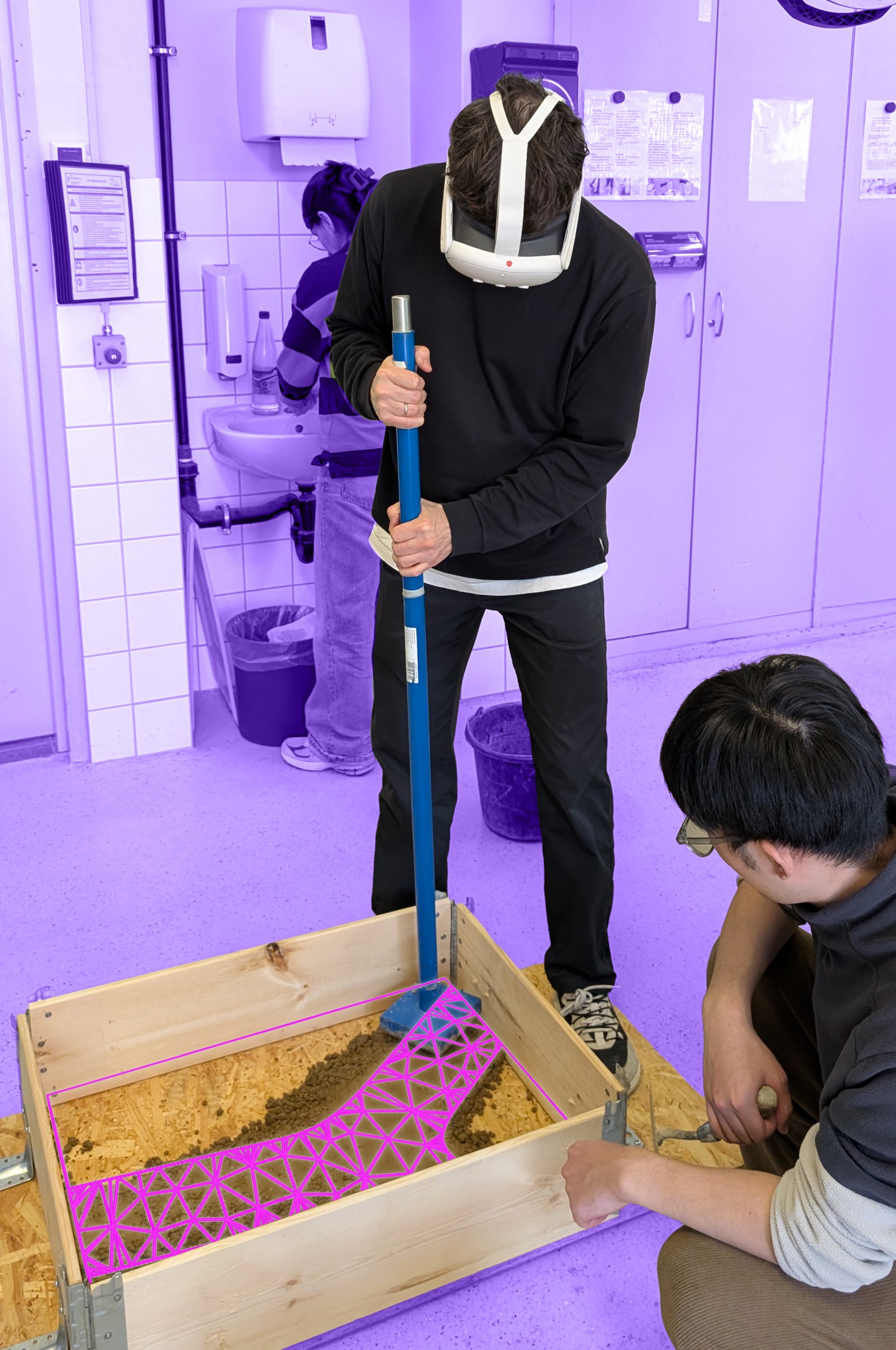
From model to material
Students developed geometries in Rhinoceros and Grasshopper, including branching structures and sculptural bodies. RADii streamed the models to pass-through headsets and smartphones. QR markers aligned the digital geometry with the physical workspace.
The overlay showed where to place earth at each layer; manual ramming then translated these instructions into a physical component. The experiments investigated how much physical support remained necessary when digital guidance was available.
Experimental prototyping · Digital fabrication course, winter semester 2025/26
Darmstadt University of Applied Sciences (h_da)
Five experiments, different constraints
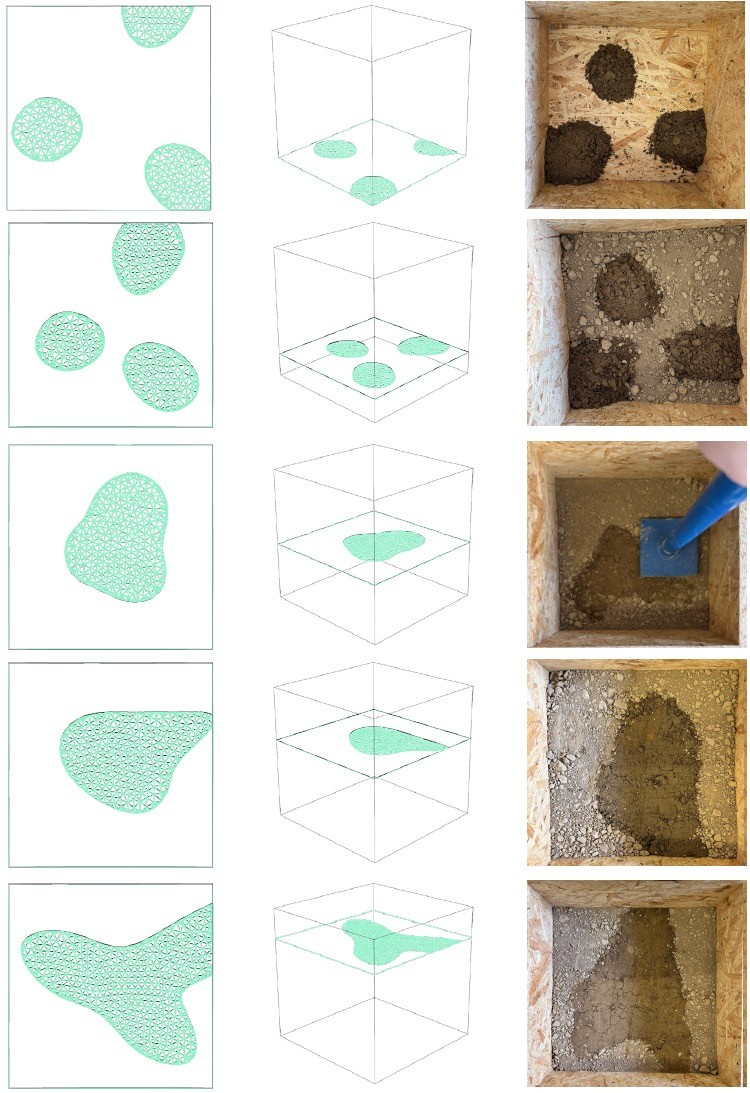
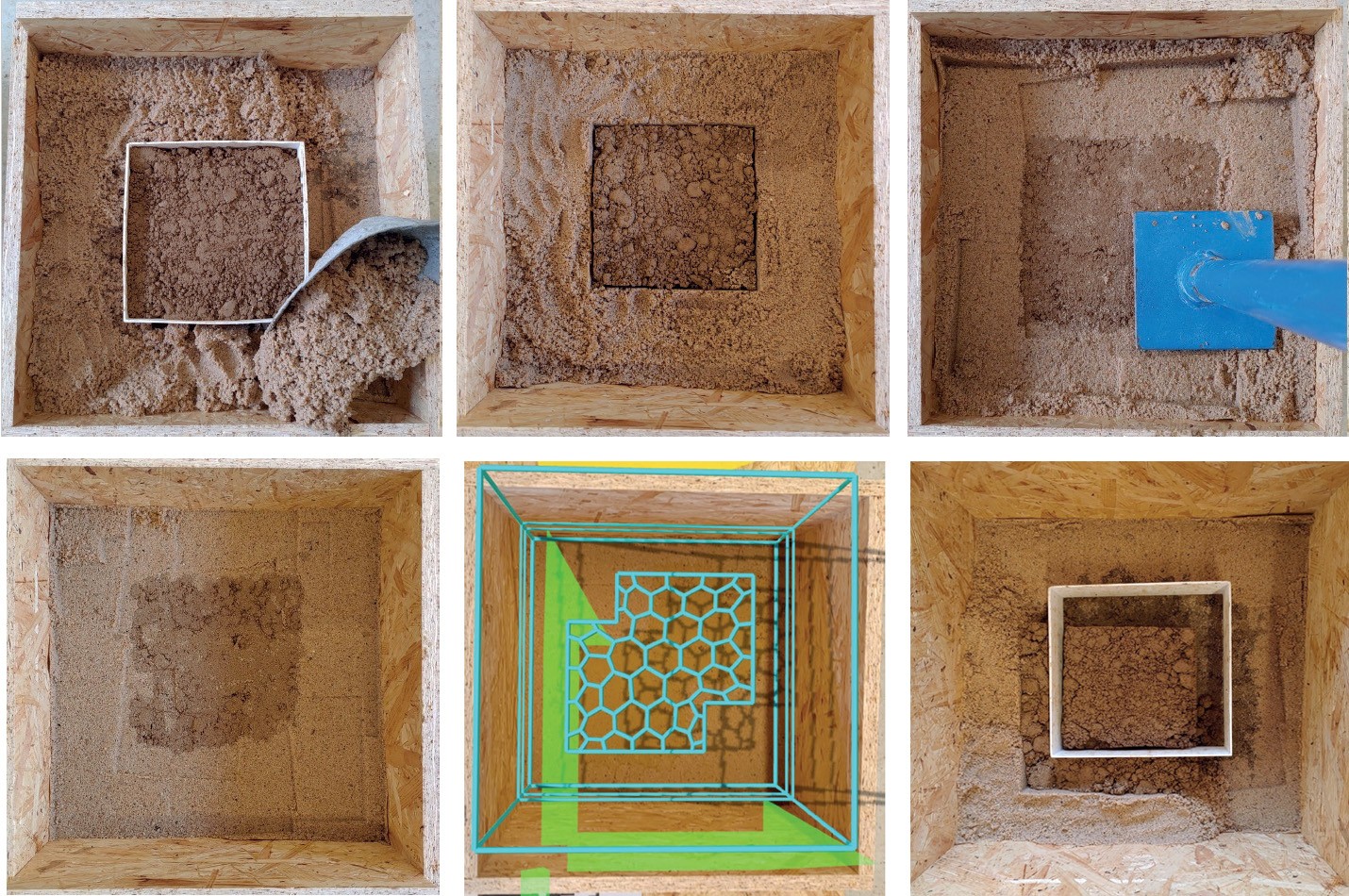
The study progressed from sand-supported filling to moveable 3D-printed formwork, selective wetting of dry earth, a branching structure and a Y-shaped path-ramming experiment. Together, these tests explored the balance between holographic guidance and physical containment.
Digital guidance meets physical resistance
The most reliable results combined AR guidance with minimal physical containment. Moveable formwork inserts supplied a tangible boundary during compaction; holographic guidance alone could not prevent the earth from spreading laterally. Selective wetting struggled with interlayer bonding.
Depth perception, consistent layer thickness and stable model registration remained challenges. Each strategy was realised as a single prototype with several changing variables: the study is exploratory, not a validation of a construction-ready system.

Research and publication
Paper authors: Bastian Wibranek, Oskar Gerspach-Wolf and Albrecht Gilka-Bötzow.
Prototyping: Students of the “Digitale Fabrikation” seminar, winter semester 2025/26, Darmstadt University of Applied Sciences.
Wibranek, B., Gerspach-Wolf, O., & Gilka-Bötzow, A. (2026). Augmenting rammed earth: AR as a interface between computational design and manual fabrication. In E. Damtsas & A. B. Spaeth (Eds.), Informed creativity in architecture and engineering: Proceedings of the 44th eCAADe Conference (Vol. 2, pp. 227–236). eCAADe.
Read the paper (DOI) · Publication entry
Images reproduced from Figures 1, 3, 5 and 6 of the paper cited above.